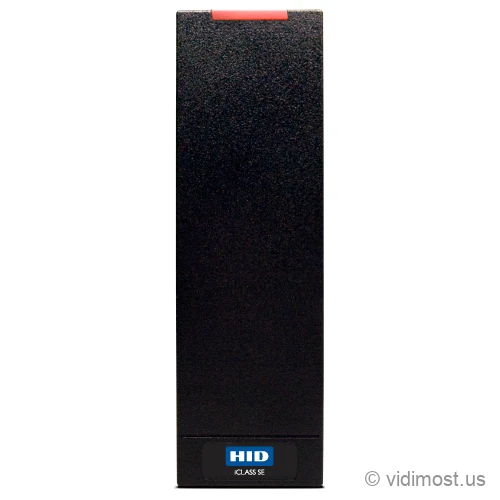
The HID iCLASS SE R15 is a slim mullion smart card reader from HID's iCLASS SE family, reading 13.56 MHz credentials on a narrow door frame. It reads iCLASS Seos, iCLASS SE, MIFARE Classic and DESFire EV1 cards, and once the HID BLEOSDP upgrade kit is added it also accepts phone credentials over HID Mobile Access.
We install and repair access control systems across Chicago, the North Shore and the northwest suburbs — ask about the R15 for your
building or business.
ReadsiCLASS Seos, iCLASS SE / iCLASS, MIFARE Classic, DESFire EV1
Frequency13.56 MHz only (no 125 kHz prox)
Mobile credentialsHID Mobile Access via BLEOSDP-UPG-A-910 kit (Bluetooth + NFC over the reader's 13.56 MHz RF)
CommunicationWiegand and Clock-and-Data standard; OSDP over RS-485 with the upgrade kit
Mullion / narrow door frame or flat surface; base plate
Environment
IP55 (IP65 with optional gasket); -35°C to 65°C
Dimensions
1.9 in x 6.0 in x 0.9 in
Security
SIO data model, EAL5+ secure element, OSDP Secure Channel, optional iCLASS Elite keying; UL 294 listed
Typical use
Security projects in Chicago North Shore – homes, small business and
multifamily buildings, depending on how the system is designed.
How we use it
As part of complete systems (cameras, access control, intercoms, networking)
rather than standalone online sales.
Product overview and installer notes
The HID iCLASS SE R15 is the mobile-ready member of the iCLASS SE mullion family: a tall, narrow 13.56 MHz smart reader that fits on a glass-door mullion or a skinny aluminum frame where a single-gang reader won't go. Out of the box it reads high-frequency smart credentials — iCLASS Seos, iCLASS SE and standard iCLASS, plus MIFARE Classic and DESFire EV1 — using the SIO data model and mutual card-to-reader authentication. What separates the R15 from the plain R10 is one add-on: the HID BLEOSDP-UPG-A-910 kit. Snap it in and the same reader starts accepting phone credentials over HID Mobile Access — a resident's phone becomes their badge with a Twist and Go gesture or a tap at the door — and it upgrades the wiring to OSDP at the same time. That kit drops in during a field upgrade through the HID Reader Manager app, no swapping the reader and no re-pulling wire. It ships wired for Wiegand and Clock-and-Data and is UL 294 listed. For a Chicago condo or office moving off legacy cards toward mobile, this is the compact reader for narrow openings.
Specs, firmware notes and availability change over time — confirm against the
manufacturer’s current documentation before ordering.
Turning a phone into a badge on iCLASS SE
The R15 is the iCLASS SE mullion reader built to take phone credentials. In its base form (part number 910N) it is a smart card reader — tap an iCLASS Seos or MIFARE card and the door opens. Add the HID BLEOSDP-UPG-A-910 upgrade kit and the same reader starts listening for phones too. That is the reason to spec an R15 over the plain iCLASS SE R10: one reader that carries a building from cards today to phones later.
Here is how a phone becomes a badge. A resident downloads the mobile app, and you issue them a credential through HID Mobile Access the same way you'd issue a card number. The credential itself is an iCLASS Seos identity living on the phone — the same encrypted format the reader already trusts on a card. At the door there are two ways to present it. Hold the phone up to the reader and it reads over NFC at short range, the same as tapping a card. Or use HID's Twist and Go gesture: with the phone in hand from a few feet away, a quick twist of the wrist opens the door over Bluetooth without pulling the phone all the way out. Both work on the same R15, and the NFC read rides on the reader's existing 13.56 MHz RF once mobile is enabled — the kit does not add a separate NFC radio.
The kit is a field upgrade, not a factory-only option. You add it later through the HID Reader Manager mobile app — the tech holds a phone to the reader, pushes the configuration, and the R15 is now mobile-ready and running OSDP without coming off the wall or re-running cable. So a building can install R15 readers now, run them on cards for a year, and switch on phone access the day the property manager is ready. If you also need 125 kHz prox cards read on the same head, that's the multiCLASS SE RP15, not this reader.
Credentials the R15 accepts
The R15 is a 13.56 MHz reader only. That single number matters: it does not read old 125 kHz HID Prox cards. If your building still runs on Prox and you want to keep those cards working while you migrate, use a dual-frequency reader like the multiCLASS SE RP15 or the newer Signo 20 instead. The R15 is for buildings already on high-frequency smart cards, or ready to switch to them.
Within 13.56 MHz it reads a wide set: iCLASS Seos (HID's current high-security format), iCLASS SE and standard iCLASS, plus MIFARE Classic and MIFARE DESFire EV1. That mix makes it a good migration reader. A condo board can leave its existing iCLASS cards in service and simply hand new residents a Seos or mobile credential as units turn over — the same reader honors both, so nobody re-badges the whole building at once. The reader also reads the card serial number (CSN) off most ISO 14443 and 15693 cards, which is handy when a property already uses a MIFARE fob for something else.
The security is built into the format, not bolted on. Seos and iCLASS SE credentials use a SIO (Secure Identity Object) data model with mutual authentication — the card and reader each prove they're genuine before any number changes hands — and an EAL5+ certified secure element holds the keys. For buildings that want their own private keyset so no off-the-shelf card can be cloned onto their doors, HID offers iCLASS Elite keying on this reader.
Power and wiring to a controller
The R15 has no PoE and no battery. It draws its power from the access control panel over the reader cable, at 5 to 16 VDC — most panels supply 12 VDC, which is also what you need if you run the reader in OSDP mode. Current draw is low: roughly 60 mA on average, and Intelligent Power Management can idle it down to about 35 mA when nothing's at the door. In practice that means a standard reader run off your panel's reader power, nothing special.
Out of the box it speaks Wiegand and Clock-and-Data, the two formats every access panel understands, so it drops into an existing system — including a Paxton Net2 door controller — the same way any card reader would. The BLEOSDP-UPG-A-910 kit moves it to OSDP over RS-485, which gives you encrypted, two-way communication between reader and controller (OSDP Secure Channel). OSDP matters for two reasons: the wire between reader and panel can't be tapped to clone credentials, and the panel can push firmware and settings back to the reader instead of you touching every door. The R15 is UL 294 listed.
Mounting and the real install
The R15 is 1.9 inches wide and 6 inches tall — a tall, skinny footprint made for a door mullion, that narrow metal or glass strip beside a glass door where a wall-switch-sized reader physically won't fit. It's the compact sibling of the single-gang iCLASS SE R40: same electronics and credential support, but shaped for tight frames instead of a wall box. It mounts on a base plate and connects by either a pigtail or a terminal strip.
Two field notes that save a callback. First, a 13.56 MHz reader loses range when it sits directly on metal, so bolting an R15 flat to an aluminum or steel frame will shorten the read. HID makes a spacer (plastic or ferrite) that lifts the antenna off the metal, and on Chicago glass-and-aluminum storefronts you'll want one on the truck. Second, weather: the R15 is rated IP55 as installed, and IP65 if you add the optional gasket, so an exterior door in a Chicago winter should get the gasket. An optical tamper option is available if you need the panel to know when a reader is pried off the wall.
Where it fits against its siblings
Think of the iCLASS SE readers as one family in three sizes and two feature levels. For mullions there's the R10 (smart cards only) and this R15 (smart cards plus field-added mobile). For a wall box there's the single-gang R40. Pick the R15 over the R10 whenever mobile access is on the table now or likely within a few years — the upgrade path is worth the small premium.
Step outside the SE line for two reasons. If you must keep reading legacy 125 kHz Prox cards during a migration, go dual-frequency with the multiCLASS SE RP15. If you're specifying a brand-new building with no legacy cards to honor, HID's current platform is Signo, which reads nearly everything and is mobile-ready by default. We install all of these across Chicago and the North Shore, often on a Brivo or Paxton back end — more on the HID line here — and we're happy to spec the right one per door rather than putting the same reader everywhere.
Common questions about the R15
Does the R15 read phone / mobile credentials out of the box?
Not in the base 910N configuration — that version is a smart card reader. To read phones you add the HID BLEOSDP-UPG-A-910 upgrade kit, which enables HID Mobile Access over Bluetooth (a Twist and Go wrist gesture from a few feet away) and NFC (tap the phone to the reader), and moves the reader to OSDP at the same time. It's a field upgrade done through the HID Reader Manager app, so you can install the R15 on cards now and switch on mobile later without replacing the reader or re-running wire.
Will the R15 read our old HID Prox (125 kHz) cards?
No. The R15 is a 13.56 MHz smart reader only and does not read 125 kHz HID Prox. If you need to keep legacy Prox cards working during a migration, use a dual-frequency reader like the multiCLASS SE RP15 or a Signo reader, which read both frequencies on one head. The R15 is the right choice once you're on smart cards or ready to move to them.
What's the difference between the R15 and the R10?
They're the same slim mullion reader with the same 13.56 MHz smart card support. The R15 is the one built to take the BLEOSDP-UPG-A-910 kit for HID Mobile Access, so a phone can become a badge over Bluetooth or NFC; the R10 stays card-only. If mobile access is anywhere in your plans, spec the R15 — the small extra cost buys you the upgrade path.
How does the R15 wire to our access control panel?
It powers from the panel over the reader cable at 5–16 VDC (12 VDC for OSDP) — there's no PoE. It ships speaking Wiegand and Clock-and-Data, so it drops into virtually any existing panel, including Paxton Net2. Adding the BLEOSDP-UPG-A-910 kit runs the reader on OSDP over RS-485 with Secure Channel, which encrypts the reader-to-controller link and lets the panel push updates back to the reader. The R15 is UL 294 listed.
Can the R15 mount on a glass door or metal mullion?
Yes — the 1.9-inch-wide body is designed for exactly those narrow frames where a single-gang reader won't fit. One caution: a 13.56 MHz reader loses read range when it sits directly on metal, so on an aluminum or steel frame add HID's mounting spacer (plastic or ferrite) to lift the antenna off the surface. On exterior doors, add the optional gasket to move the rating from IP55 up to IP65 for Chicago weather.
Is the R15 secure enough for a multi-family building?
Yes. Seos and iCLASS SE credentials use mutual authentication and an EAL5+ certified secure element, so a card and reader verify each other before any data moves. Running the reader in OSDP mode adds an encrypted, supervised link to the controller, and iCLASS Elite keying lets a property use its own private keyset so no generic card can be cloned onto its doors. The reader is UL 294 listed.
Service, upgrade and maintenance
If you already have HID hardware on site and the system is unstable,
we can audit it, fix urgent issues and plan upgrades step by step instead of
forcing a complete replacement. This includes systems originally installed by
other vendors.
We offer free estimates for projects in our service area. New
service clients also receive a 50% discount on the first service visit
for troubleshooting and diagnostics, including systems we did not install.
To move forward, go to the Contact page and mention model R15 in your message. You can also attach photos of
your existing equipment, panels or racks to speed up the design and service
process.