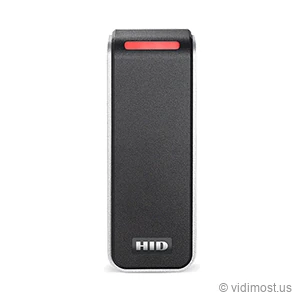
The HID Signo 20 is a mullion-mount door reader from HID's newest Signo line. It reads legacy 125 kHz prox, 13.56 MHz smart cards, and phones over Bluetooth and NFC in one narrow device, and supports an employee badge in Apple Wallet on supported setups.
We install and repair access control systems across Chicago, the North Shore and the northwest suburbs — ask about the Signo 20 for your
building or business.
Form factorMullion-mount reader (narrow door-frame width)
Over 15 common credential technologies (per HID datasheet)
Comms to controller
Wiegand or RS-485 (OSDP), with OSDP Secure Channel
Power
12V DC from the access panel; no PoE
Mounting
Door mullion or any flat surface; reads on/near metal (spacer recommended)
Environment
IP65, UL294 indoor/outdoor, -31°F to +150°F
Typical use
Security projects in Chicago North Shore – homes, small business and
multifamily buildings, depending on how the system is designed.
How we use it
As part of complete systems (cameras, access control, intercoms, networking)
rather than standalone online sales.
Product overview and installer notes
The Signo 20 packs almost every credential a building runs into one narrow mullion housing. It reads old 125 kHz cards and fobs (HID Prox, Indala, AWID, EM), modern 13.56 MHz smart cards (Seos, iCLASS SE, iCLASS, MIFARE Classic and DESFire), and phones over both Bluetooth and NFC. Mobile is built in, not an add-on module, so a resident or employee can hold up a phone running HID Mobile Access instead of a card. On supported setups it also reads an employee badge stored in Apple Wallet through Apple's Enhanced Contactless Polling, so the credential lives on a phone people already carry. HID's datasheet lists support for over 15 common credential technologies, which is why Signo has become the default reader on new access-control work and the practical choice for buildings that want to retire old cards without swapping hardware twice. It talks to your controller over Wiegand or OSDP, mounts on a door mullion or any flat surface, and carries an IP65, UL294 indoor/outdoor rating for exterior gates and doors.
Specs, firmware notes and availability change over time — confirm against the
manufacturer’s current documentation before ordering.
Why Signo became the default reader
The reason to pick a Signo 20 over an older single-purpose reader is coverage. One narrow reader on the door frame handles almost every card, fob, and phone your building is likely to use. That includes 125 kHz proximity cards from the last two decades (HID Prox, Indala, AWID, EM), 13.56 MHz smart cards (Seos, iCLASS SE, iCLASS, MIFARE Classic, MIFARE DESFire), and mobile credentials over Bluetooth and NFC. HID's datasheet puts it at over 15 credential technologies in a single device.
Mobile is part of the reader, not an extra board you bolt on. A resident or employee runs HID Mobile Access on their phone and taps or approaches the door the same way they would with a card. On supported setups the reader also accepts an employee badge stored in Apple Wallet, using Apple's Enhanced Contactless Polling, so the credential sits on a phone people already carry and never leaves home. (Google Wallet isn't named in HID's documentation for this model, so we don't claim it.) Mobile Access needs version 3.0.0 or newer on a phone with Bluetooth 4.0 or later.
Underneath, Signo stores its keys in an EAL5+ certified secure element and talks over OSDP Secure Channel for encrypted, two-way communication. That matters for two reasons: the credential exchange is protected against copying and eavesdropping, and readers can be reconfigured or firmware-updated over the wire through HID Reader Manager or the panel, without a truck rolling to touch each door. For the platform picture across the Signo family, see the HID brand overview and our access control service.
Cards, fobs and phones it reads at the door
Buildings almost never run one kind of card. You might have old blue Prox cards from a 2008 install, newer iCLASS badges from a later upgrade, and a maintenance crew that wants to use phones. The Signo 20 reads all three at the same door. The 125 kHz side covers the legacy prox families (HID Prox, Indala, AWID, EM). The 13.56 MHz side covers modern encrypted smart cards (Seos, iCLASS SE, MIFARE DESFire and others). Mobile rides on top of that.
This is what makes it a migration reader. Install Signo readers now while everyone still carries their old cards, then move a building at a time: hand out new smart cards or phone credentials floor by floor, replace worn prox cards as they come up for renewal, and once the last old card is out of circulation, switch off 125 kHz support in software. No second hardware swap. If you only need one credential type today, note that specific order configs are factory-keyed to a profile (for example a 13.56 MHz Seos or iCLASS SE profile, with 125 kHz added on certain SKUs), so tell us the exact card mix and we'll spec the right part.
If your building is purely legacy prox and you don't need the smart-card or mobile headroom, a simpler prox-only reader like the HID MiniProx 5365 can be the cheaper fit. If you want the modern smart-card and mobile side but not the old 125 kHz support, the iCLASS SE R15 covers 13.56 MHz and mobile in a similar mullion size.
Power and wiring to your controller
The Signo 20 runs on 12V DC supplied from the access control panel. There is no PoE on this reader; power comes from a listed UL294 power-limited supply at the panel, the same as most door readers. Current draw is low, about 70 mA average (250 mA peak), so it doesn't strain a typical panel power budget.
It connects to the controller over Wiegand or RS-485 (OSDP), selectable, delivered on an 18-inch pigtail or a terminal strip depending on the part you order. Wiegand is the old standard and works with almost any panel, with runs up to about 500 ft. OSDP is the newer path: it's encrypted, two-way, and supports remote configuration and firmware updates, with much longer cable runs (RS-485 bus up to roughly 4,000 ft). If your panel supports OSDP, we usually wire it that way for the security and the remote-management benefit. These readers wire cleanly to controllers like the Paxton Net2 Plus 1-door controller over Wiegand, and they also fit cloud-managed platforms such as Brivo.
Mounting and the real install
The Signo 20 is narrow on purpose. It fits on a door mullion, the slim metal frame beside a glass door, where a wider single-gang reader wouldn't. It also mounts on any flat surface: directly to a wall with the supplied self-tapping screws, no junction box needed, or over a US or EU junction box using the included screw sets. A mounting plate hooks the reader at the top and anchors it with one screw, and there's an anti-tamper security screw in the box for exposed doors.
One Signo feature worth calling out is surface detection. The reader senses what it's mounted on, metal, glass, or drywall, and recalibrates its read range so performance stays consistent. Mount it against a metal frame or metal box and the range tightens up a little; drop in HID's reader spacer in that spot and you get the full read distance back. Keep it on a flat, stable surface so the IP65 seal and tamper switch work as intended.
For exterior gates and doors, the IP65 and UL294 indoor/outdoor rating and the -31°F to +150°F operating range hold up to Chicago and the North Shore weather. If you need a keypad for card-plus-PIN at a sensitive door, we spec the Signo 20K instead, which is the same reader with a keypad.
Where the Signo 20 fits vs its siblings
The Signo 20 is the mullion size in the Signo line. If your reader location is a standard single-gang wall box rather than a narrow frame, the Signo 40 is the same platform in a wider body with a bit more read range. Need a keypad for two-factor at the door? The Signo 20K (mullion) or Signo 40K (single-gang) add PIN entry. If the budget is tight and the site is mobile-first, Signo Express trims the credential list to keep costs down.
Compared with the older dual-tech readers, Signo is the newer platform. A multiCLASS SE RP10 also reads both 125 kHz prox and 13.56 MHz smart cards in a mullion, and it's a fine choice on an existing multiCLASS site. On new work we lead with Signo for the wider credential list, the built-in mobile and Apple Wallet support, surface detection, and the remote-management path over OSDP. Hand us a mixed building with old cards and a push toward phones, and the Signo 20 is the reader that covers it without a second hardware change.
Common questions about the Signo 20
Will the Signo 20 read our existing prox cards?
Most likely yes. It reads the common 125 kHz prox families, HID Prox, Indala, AWID, and EM, alongside modern 13.56 MHz smart cards. So you can install it now, keep using your current cards, and migrate to smart cards or phones on your own schedule. Send us a sample card or the card part number and we'll confirm the exact match before ordering, since specific configs are factory-keyed to a credential profile.
Does mobile phone access really come built in?
Yes. Bluetooth and NFC mobile support is part of the reader, not an add-on. Users run HID Mobile Access on their phone and present it at the door like a card. On supported setups the reader also accepts an employee badge stored in Apple Wallet through Apple's Enhanced Contactless Polling. Mobile Access needs version 3.0.0 or later on a phone with Bluetooth 4.0 or newer. Google Wallet isn't named in HID's documentation for this model, so we don't promise it.
How does it connect to our access control panel?
Over Wiegand or OSDP (RS-485), your choice, on either a pigtail or a terminal-strip version. Power is 12V DC from the panel; there's no PoE. If your panel supports OSDP we usually wire it that way, because OSDP is encrypted, two-way, and lets us update or reconfigure the reader remotely instead of touching each door. For older panels, Wiegand works fine and is the most widely compatible option.
Should I choose the Signo 20 or the Signo 40?
It comes down to where the reader mounts. The Signo 20 is the narrow mullion version for door frames, especially beside glass doors. The Signo 40 is the same platform in a wider single-gang body with slightly more read range, for standard wall-box locations. Both read the same credentials and both support mobile. If you need a PIN pad at the door, step up to the Signo 20K or 40K.
Can it be used on an outdoor gate?
Yes. It's rated IP65 and UL294 for both indoor and outdoor use, with an operating range of -31°F to +150°F, which covers Chicago and North Shore winters and summers. Mount it on a flat, stable surface so the weather seal and tamper switch work properly, and we'll add a reader spacer if it's going on or near a metal frame.
We're on an older multiCLASS system. Is it worth switching to Signo?
If your existing multiCLASS readers work and you're not changing credentials, there's no urgency. But on new doors or a system refresh we lead with Signo because it reads a wider list of credentials, has mobile and Apple Wallet support built in, adds surface detection for consistent read range, and supports remote firmware and config updates over OSDP. It's also the reader that lets you retire old cards without a second hardware swap down the road.
Service, upgrade and maintenance
If you already have HID hardware on site and the system is unstable,
we can audit it, fix urgent issues and plan upgrades step by step instead of
forcing a complete replacement. This includes systems originally installed by
other vendors.
We offer free estimates for projects in our service area. New
service clients also receive a 50% discount on the first service visit
for troubleshooting and diagnostics, including systems we did not install.
To move forward, go to the Contact page and mention model Signo 20 in your message. You can also attach photos of
your existing equipment, panels or racks to speed up the design and service
process.