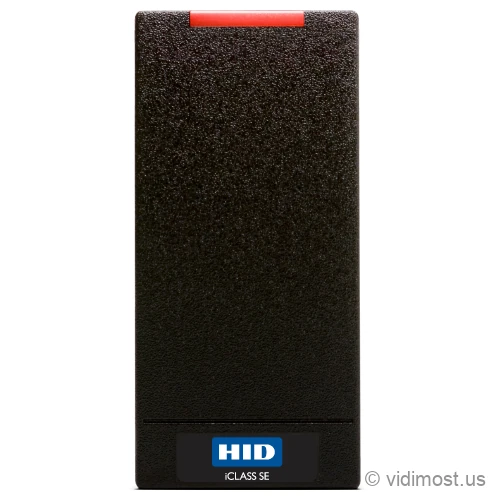
The HID iCLASS SE R10 is a mini-mullion door reader that reads 13.56 MHz smart credentials — iCLASS Seos, iCLASS SE, MIFARE Classic, and DESFire EV1. It is the smallest reader in HID's iCLASS SE family, sized to fit narrow aluminum door mullions on glass storefronts and framed entrances. It is a smart-card reader only; it does not read 125 kHz HID Prox.
We install and repair access control systems across Chicago, the North Shore and the northwest suburbs — ask about the R10 for your
building or business.
Reader familyHID iCLASS SE (base part number 900N)
Frequency13.56 MHz smart-card only (does not read 125 kHz Prox)
Wiegand, Clock-and-Data, or OSDP over RS-485 with Secure Channel
Cable run
Up to 500 ft (150 m) on 22 AWG shielded (Wiegand/Clock-and-Data)
Power
5-16 VDC; ~35 mA with Intelligent Power Management @ 16 VDC (vs ~60 mA standard)
Form factor
Mini-mullion, 1.9 x 4.1 x 0.9 in — smallest reader in the SE line
Environment
IP55 (IP65 with gasket), -35 to 65 C; UL294/cUL listed
Typical use
Security projects in Chicago North Shore – homes, small business and
multifamily buildings, depending on how the system is designed.
How we use it
As part of complete systems (cameras, access control, intercoms, networking)
rather than standalone online sales.
Product overview and installer notes
The R10 puts HID's iCLASS SE platform in its most compact body. iCLASS SE is HID's 13.56 MHz smart-credential architecture, and it works differently from the 125 kHz proximity cards most older buildings still carry. A 13.56 MHz smart card holds an encrypted data object — HID calls it an SIO, and it is on by default on the newer Seos credentials — protected by diversified keys, so the credential and the reader verify each other instead of the card simply broadcasting a fixed number the way a prox card does. That is the reason to move to iCLASS SE: a prox card can be copied at a kiosk in minutes, and an iCLASS Seos card cannot be cloned the same way. The R10 reads iCLASS Seos, iCLASS SE/SR, standard iCLASS, MIFARE Classic, and MIFARE DESFire EV1, and it talks to a controller over Wiegand, Clock-and-Data, or OSDP with Secure Channel. Its mini-mullion body — under two inches wide — is what lets it go on aluminum-framed glass doors where a single-gang reader will not fit. Add HID's Bluetooth Smart module and it also reads phones through HID Mobile Access.
Specs, firmware notes and availability change over time — confirm against the
manufacturer’s current documentation before ordering.
iCLASS SE, explained: why a 13.56 MHz smart card beats 125 kHz prox
Most older Chicago buildings run on 125 kHz proximity cards. A prox card is simple: it holds one fixed number and broadcasts it to any reader that asks. That number is not encrypted, and there is nothing on the card that checks who is reading it. Anyone with a cheap copier can capture that number off a card in a pocket and write a working duplicate in minutes. That is the weakness the iCLASS SE platform was built to close.
The R10 is a 13.56 MHz smart-card reader, and 13.56 MHz cards are small computers, not passive tags. HID stores the credential inside an encrypted data object called an SIO (Secure Identity Object), and on the current Seos credentials that data model is on by default. The card and the reader hold matching cryptographic keys and prove themselves to each other before any credential number is exchanged. HID also uses key diversification — every card carries a unique key derived from a master key rather than one shared key across the whole site — so compromising a single card does not compromise the batch.
The practical result is the reason to make the switch: a Seos or iCLASS SE credential resists the copy-at-a-kiosk cloning that prox cards fall to. The credential is bound to its data with encryption, and the secure element inside the reader carries an EAL5+ certification. This R10 page is the anchor for the whole iCLASS SE family on our catalog — the R15 and the single-gang R40 run the same platform and the same credentials; they differ mainly in size and mounting.
Credentials the R10 accepts — and the one it doesn't
Read this part carefully, because it is where buildings get tripped up. The R10 is 13.56 MHz only. It reads iCLASS Seos, iCLASS SE and SR, standard iCLASS (order the standard interpreter for the native iCLASS application), MIFARE Classic, and MIFARE DESFire EV1. It also reads card serial numbers from ISO 14443A/B and ISO 15693 cards. What it does not do is read 125 kHz HID Prox. If your residents still carry old prox fobs, an R10 will not open the door for them.
So the R10 fits two situations. One: a new building or a fresh access-control cutover where every credential is issued on 13.56 MHz smart cards or phones from day one. Two: a site that has already finished migrating off prox. If you are mid-migration and need one reader to accept both the old prox fobs and new smart cards during the transition, you want the dual-frequency sibling — the multiCLASS SE RP10, which is the same mini-mullion body but reads 125 kHz prox and 13.56 MHz smart credentials at once.
For phones, the R10 supports HID Mobile Access and NFC smartphone credentials through Seos when it is equipped with HID's Bluetooth Smart module. A reader shipped without that module can be upgraded in the field using the Bluetooth Smart / OSDP kit and the HID Reader Manager app — no wall demolition, no new cable.
Power and wiring: how it connects to a controller
The R10 wires to an access controller three ways: Wiegand, Clock-and-Data, or OSDP over RS-485. Wiegand is the classic, universally compatible option and runs to 500 ft on 22 AWG shielded cable — that reaches almost any door from a closet-mounted panel. OSDP is the better choice on new work: it is a two-way protocol, and its Secure Channel (SCP) encrypts the link between reader and controller so the credential data is protected on the wire, not just on the card. If you are putting encrypted smart cards on the reader, running OSDP Secure Channel back to the panel keeps that protection end to end.
It runs on 5 to 16 VDC from a linear or regulated supply. With HID's Intelligent Power Management turned on it draws about 35 mA at 16 VDC, against roughly 60 mA in standard mode — about ~40% lower current than standard mode, which matters when several readers share one power supply. The reader comes as a pigtail or a terminal-strip version; the terminal-strip build is a little lighter and easier to service at the box. On our access-control installs we most often wire iCLASS SE readers to a Paxton Net2 Plus controller over Wiegand, though the R10 also fits cloud platforms like Brivo that accept standard reader outputs.
Mounting and the real install situation
The R10 is the smallest reader HID makes in the iCLASS line — 1.9 by 4.1 inches. That narrow body is what earns its place on the job. Aluminum-framed glass storefront doors and slim entry mullions do not have room for a single-gang reader, and the R10 slides right onto them. It mounts on a mullion, on a U.S. single-gang J-box with a mud ring, or on any flat surface.
One field detail catches people out: set the R10 flush against an aluminum frame and the metal pulls its read range down, commonly by a fifth or more, because the frame throws off the antenna's tuning. HID's reader spacer (PN 6132AKB) lifts it off the metal and gives the range back. Leave the spacer out and residents end up mashing cards against the reader to get a read.
Outdoors, the R10 is rated IP55 as shipped and IP65 with the optional mounting gasket, and it holds up from -35 to 65 C — which covers a Chicago winter door and a west-facing summer entrance without complaint. If you need a wider single-gang reader instead of the mullion size, the R40 takes the same credentials in a larger body.
Where the R10 fits against its siblings
Inside the iCLASS SE family, size and mobile readiness set the three apart. The R10 is the mini-mullion for tight door frames. The R15 is the mobile-ready mullion. The R40 is the single-gang, for wider mounting surfaces and longer read range. All three read the same 13.56 MHz smart credentials.
The bigger decision is prox versus no prox. If any part of your credential base is still on 125 kHz, do not buy an R10 — buy the dual-technology multiCLASS SE RP10. It reads both frequencies at the same head, so you can run prox and smart side by side and turn off 125 kHz acceptance in software once the last old card is reissued. And if you are starting fresh in 2026 with no prox at all, it is worth comparing the R10 to HID's newer Signo 20 multi-tech mullion, which reads a wider mix of credentials out of the box. For coming off 125 kHz specifically, our prox pages — the MiniProx 5365 and ProxPoint Plus 6005 — cover what those older cards can and cannot do. If you want us to walk the doors and pick the right reader per opening, that is what our access control service in Chicago and the North Shore does.
Common questions about the R10
Will the iCLASS SE R10 read our existing 125 kHz prox cards?
No. The R10 is a 13.56 MHz smart-card reader only. It does not read 125 kHz HID Prox at all, so old prox fobs will not open a door with an R10 on it. If you still have prox cards in circulation, use the dual-frequency multiCLASS SE RP10 — same mini-mullion size, but it reads both 125 kHz prox and 13.56 MHz smart credentials so you can migrate on your own timeline.
What smart cards does it read?
iCLASS Seos, iCLASS SE and SR, standard iCLASS (with the standard interpreter ordered), MIFARE Classic, and MIFARE DESFire EV1. It also reads the card serial number off most ISO 14443A/B and ISO 15693 cards. HID's family datasheet lists DESFire support up to EV1 for this SE-generation reader; if you are standardizing on newer DESFire, ask us and we will confirm the right reader for your credential.
Can it read phones and mobile credentials?
Yes, when it is equipped with HID's Bluetooth Smart module. With that module it supports HID Mobile Access and NFC smartphone credentials through iCLASS Seos. A reader that shipped without the module can be field-upgraded using the Bluetooth Smart / OSDP kit and the HID Reader Manager app, so you do not have to swap the hardware to add phones later.
How does it wire to our access control panel?
Three ways: Wiegand, Clock-and-Data, or OSDP over RS-485. Wiegand runs to 500 feet on 22 AWG shielded cable and works with essentially any controller. For new installs we prefer OSDP with Secure Channel, which encrypts the link between the reader and the controller so the credential is protected on the wire, not just on the card. It runs on 5 to 16 VDC, and about 35 mA at 16 VDC with Intelligent Power Management on.
Is it OK to mount on an aluminum glass door frame?
Yes — that narrow mullion mount is exactly what the R10 is built for at 1.9 inches wide. One caution: an aluminum frame right behind the reader shaves read range by a fifth or more. HID's reader spacer (PN 6132AKB) holds it off the metal and brings the range back. It is IP55 rated as shipped and IP65 with the optional gasket, so an exterior door is fine.
R10, R15, or R40 — which one do we need?
All three run the same iCLASS SE platform and read the same 13.56 MHz credentials; the difference is size and mobile readiness. Pick the R10 for narrow mullions on glass and framed doors, the R15 when you want the mobile-ready mullion, and the R40 single-gang for wider mounting surfaces and a bit more read range. If any of your cards are still 125 kHz prox, skip all three and go dual-tech with the RP-series instead.
Service, upgrade and maintenance
If you already have HID hardware on site and the system is unstable,
we can audit it, fix urgent issues and plan upgrades step by step instead of
forcing a complete replacement. This includes systems originally installed by
other vendors.
We offer free estimates for projects in our service area. New
service clients also receive a 50% discount on the first service visit
for troubleshooting and diagnostics, including systems we did not install.
To move forward, go to the Contact page and mention model R10 in your message. You can also attach photos of
your existing equipment, panels or racks to speed up the design and service
process.