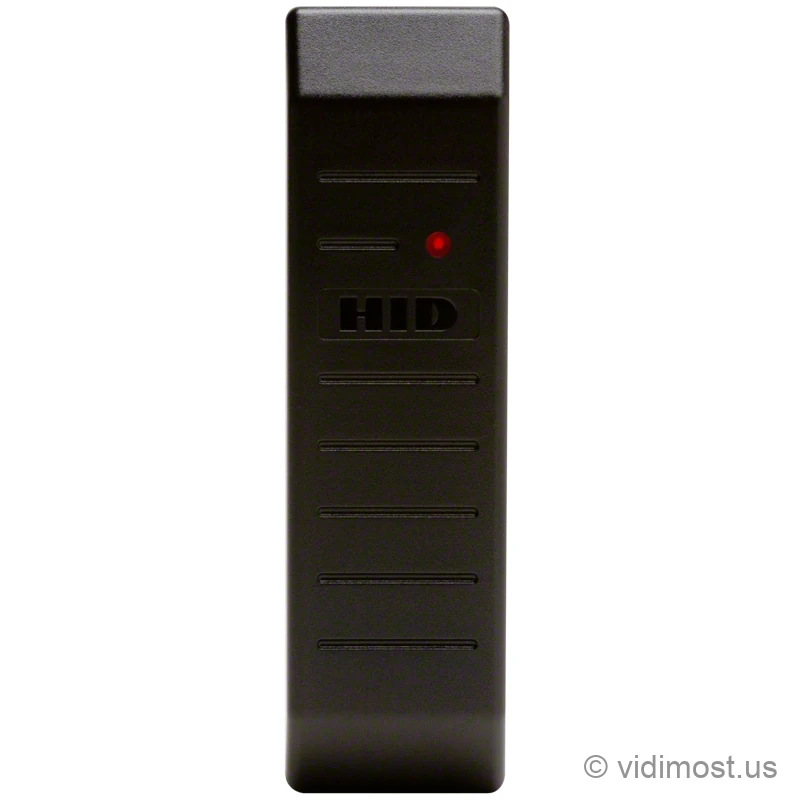
The HID MiniProx 5365 is a slim, mullion-mount 125 kHz proximity reader sized to sit on a narrow metal door frame. It reads HID Prox credentials and sends a Wiegand signal to your access control panel. Part of HID's Prox reader family, it's the reader to fit when the mounting surface is a tight steel or aluminum mullion.
We install and repair access control systems across Chicago, the North Shore and the northwest suburbs — ask about the 5365 for your
building or business.
Credential type125 kHz HID Prox only (ProxCard II, ISOProx II, ProxKey II, etc.)
Read rangeUp to 5.5 in (14 cm) on a ProxCard II
Card formatsUp to 85 bits, over 137 billion codes
Output / commsWiegand (no OSDP); cable run up to 500 ft (150 m)
Mullion mount; installs directly on metal with no range loss
Dimensions
6.0 x 1.7 x 1.0 in (15.2 x 4.3 x 2.54 cm)
Environment
IP55, -22 to 150 F, UL 294 listed; indoor/outdoor
Mobile / smart cards
None — no iCLASS, Seos, MIFARE, or phone credentials
Typical use
Security projects in Chicago North Shore – homes, small business and
multifamily buildings, depending on how the system is designed.
How we use it
As part of complete systems (cameras, access control, intercoms, networking)
rather than standalone online sales.
Product overview and installer notes
The MiniProx 5365 is HID's mullion-mount Prox reader, a tall, slim unit measuring 6.0 x 1.7 x 1.0 inches so it fits the narrow metal frame beside a glass door. What sets it apart from a wider reader is physical: it mounts straight onto metal, including a steel or aluminum door mullion, and keeps its read range. Most readers lose range when you screw them to metal because the frame detunes the antenna, so installers choose the 5365 exactly where that would be a problem. On a standard ProxCard II you get up to about 5.5 inches of read range, plenty for a tap-and-go entry. It reads 125 kHz HID Prox credentials only and sends a Wiegand output down a run of up to 500 feet to your access control panel, so it drops into any existing Wiegand system. Power is a simple 5 to 16 VDC. Sealed, potted electronics in an IP55 polycarbonate housing rated from -22 to 150 F let it live on an outdoor entry through a Chicago winter.
Specs, firmware notes and availability change over time — confirm against the
manufacturer’s current documentation before ordering.
Built for the narrow metal door frame
The 5365 is a mullion reader, shaped to fit the slim vertical strip of metal beside a glass storefront or lobby door where a wider reader simply won't go. It's 1.7 inches across, so it lands cleanly on a standard aluminum or steel mullion with room for the screws. That skinny footprint is what the reader is for.
The part installers actually care about is what happens when you put a prox reader against metal. Metal detunes the reader's antenna and shrinks the read range, sometimes to the point where a card only works if you press it flat and hold it there. The MiniProx is engineered so it mounts directly onto metal, including a door mullion, with no change in read-range performance. You get the same range on a steel frame that you'd get in open air.
On a standard ProxCard II, that range is up to about 5.5 inches — a comfortable tap without fishing for the exact sweet spot. It comes with a junction box that screws to the surface through four holes, and you can order it with a pigtail or a terminal strip depending on how you like to make up your connections. If you need an even smaller reader for a really tight jamb, the ProxPoint Plus 6005 is HID's most compact Prox unit; for a flat interior wall next to the door rather than the frame, the ThinLine II 5395 is the thin wall-switch shape.
Which HID Prox credentials the 5365 reads
This is a 125 kHz HID Prox reader, and only that. It reads the standard HID Prox lineup: ProxCard II, ISOProx II, DuoProx II, ProxCard Plus, the ProxKey II keyfob, and the MicroProx tag. If your building already hands out white HID prox cards or blue keyfobs, this reader reads them.
It recognizes card formats up to 85 bits — over 137 billion unique codes — so it works with essentially any HID Prox format your system is programmed for. It will also read the 125 kHz prox side of a dual-technology "Proximity & MIFARE" card. That opens up a slow, low-drama migration: leave the 5365 in place, keep every existing prox card working, and hand out dual-tech cards only as staff turn over or old cards wear out, until you're ready to switch readers on the doors that need smart credentials.
The 5365 does not read 13.56 MHz smart credentials — no iCLASS, iCLASS SE, Seos, or MIFARE — and it has no mobile support, so phones and wallet badges won't work on it. That's by design; it's a proven, low-power 125 kHz reader. If you want smart cards or phone-based entry on the same mullion shape, look at the multiCLASS SE RP10, which adds 13.56 MHz while still reading your old prox cards, or the newer Signo 20, which handles prox, smart cards, and mobile in one reader.
Power and wiring to your controller
Wiring is straightforward. The reader takes 5 to 16 VDC and draws very little — about 30 mA on average — so it's easy on a power supply. HID recommends a linear supply for the cleanest read performance. There's no PoE; you run power and data out to the reader on the usual multi-conductor access cable.
For data it uses Wiegand output, the long-standing signaling that virtually every access control panel accepts. That means the 5365 drops into an existing Wiegand system without changing the head-end — it wires straight to a panel like the Paxton Net2 Plus door controller and reports card reads to it. You can run the Wiegand cable up to 500 feet from reader to panel.
One thing to know going in: this reader does not do OSDP or RS-485 secure channel. Wiegand is a one-way signal and isn't encrypted on the wire, which is fine for most interior and low-risk doors but is worth weighing on a high-security opening. If encrypted OSDP is a requirement, that points you toward the Signo or iCLASS SE families rather than a legacy Prox reader.
The real install situation, and where it holds up
Field conditions are where the 5365 earns its keep. The electronics are potted — sealed in a solid compound — inside an IP55 polycarbonate enclosure rated for a wide temperature swing, from -22 to 150 F. On a Chicago exterior door that faces January wind and July sun, a sealed reader is the difference between one that keeps reading and one that fogs up or corrodes. The polycarbonate housing also gives it a good measure of vandal resistance at a pushed or picked-at entry.
It's UL 294 listed for access control, so it satisfies the listing most AHJs and insurers expect on a controlled door. The unit is compact and light, and because it mounts on the frame rather than the wall, it keeps the glass and finish around the door clean. We install these across HOA and multi-family entries throughout Chicago and the North Shore, usually where a property already runs HID prox and wants matching readers on additional doors. You can see the full lineup on our HID brand page, and how we scope a job on our access control service page.
Where it fits against its siblings
Pick the 5365 when three things are true: you're mounting on a narrow metal door frame, your credentials are 125 kHz HID Prox, and your panel takes Wiegand. That's a very common combination on older and mid-life systems, and this reader is the clean match for it.
Step outside those lines and a sibling fits better. Need the same prox on a flat interior wall? The ThinLine II 5395. Tightest possible reader? The ProxPoint Plus 6005. Adding 13.56 MHz smart cards to the same mullion while keeping prox? The multiCLASS SE RP10. Want prox, smart cards, and phone credentials in the newest hardware? The Signo 20, or the Signo 20K if you also want a keypad. Not sure which way your building should go? We'll walk the doors with you and spec it.
Common questions about the 5365
Will the MiniProx 5365 read my existing HID prox cards and fobs?
Yes, if they're 125 kHz HID Prox credentials — ProxCard II, ISOProx II, DuoProx II, the ProxKey II keyfob, or a MicroProx tag. It reads formats up to 85 bits, so it works with essentially any HID Prox format your system is already programmed for. It will not read 13.56 MHz smart cards like iCLASS or Seos.
Can I mount it on a metal door frame without losing read range?
Yes, that's exactly what it's built for. Most prox readers lose range when screwed to metal because the frame detunes the antenna, but the 5365 mounts directly onto metal, including a door mullion, with no change in read range. You'll get up to about 5.5 inches of read on a standard ProxCard II whether it's on steel or in open air.
Does it support phones or mobile credentials?
No. This is a 125 kHz proximity-only reader with no Bluetooth, NFC, or mobile support, so phone and wallet badges won't work on it. If you want mobile entry on the same mullion shape, look at the multiCLASS SE RP10 or the Signo 20, both of which add phone credentials while still reading older prox cards.
How does it wire to my access control panel?
It uses Wiegand output, which nearly every access panel accepts, so it drops into an existing Wiegand system with no change to the head-end. Power is 5 to 16 VDC — no PoE — and you can run the cable up to 500 feet from reader to panel. It comes with a junction box and is available with either a pigtail or a terminal strip. It does not support OSDP or encrypted secure channel.
What's the difference between the 5365 and the 5368?
The 5365 sends a Wiegand signal, which is what most modern access panels use. The 5368 is the same reader but outputs Clock-and-Data, which emulates a magnetic-stripe reader. The 5368 is the drop-in choice when you're upgrading a building off mag-stripe cards to prox, because it can reuse the existing mag-stripe wiring, but its cable distance is limited to about 50 feet.
Is it rated for outdoor doors in Chicago weather?
Yes. The electronics are potted and sealed inside an IP55 polycarbonate housing rated from -22 to 150 F, so it handles a Chicago winter and summer on an exterior entry. It's also UL 294 listed for access control and offers solid vandal resistance, which is why we use it on outdoor and high-traffic doors across Chicago and the North Shore.
Service, upgrade and maintenance
If you already have HID hardware on site and the system is unstable,
we can audit it, fix urgent issues and plan upgrades step by step instead of
forcing a complete replacement. This includes systems originally installed by
other vendors.
We offer free estimates for projects in our service area. New
service clients also receive a 50% discount on the first service visit
for troubleshooting and diagnostics, including systems we did not install.
To move forward, go to the Contact page and mention model 5365 in your message. You can also attach photos of
your existing equipment, panels or racks to speed up the design and service
process.