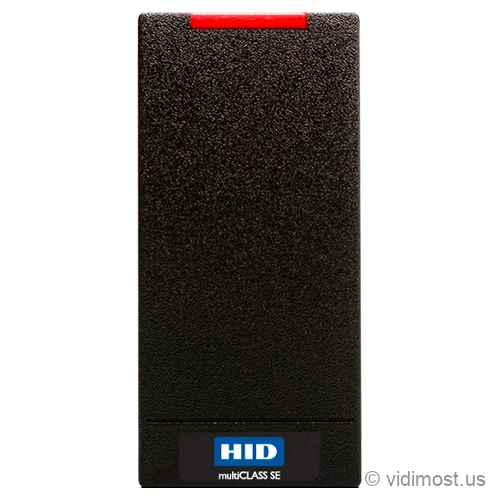
The HID multiCLASS SE RP10 is a mini-mullion door reader from HID's iCLASS SE platform that reads 125 kHz prox cards and 13.56 MHz smart credentials on one unit. It fits narrow door frames where wider readers won't, and it lets a building leave old Prox badges behind without collecting every card at once. Now a legacy model, still common on doors across Chicago.
We install and repair access control systems across Chicago, the North Shore and the northwest suburbs — ask about the RP10 for your
building or business.
TypeMini-mullion multi-technology smart card reader (HID iCLASS SE platform)
Wiegand / Clock-and-Data standard; optional OSDP with Secure Channel over RS-485
Wiring reach
Up to 500 ft (150 m) on 22 AWG shielded cable (Wiegand)
Power
5-16 VDC from the access panel; no PoE; IPM mode cuts draw up to 75%
Mounting
US single-gang J-box (with mud ring) or any flat surface
Environment
IP55 (IP65 achievable with HID's R10/RP10 gasket kit, IP65GSKT-R10); -35 C to 65 C
Typical use
Security projects in Chicago North Shore – homes, small business and
multifamily buildings, depending on how the system is designed.
How we use it
As part of complete systems (cameras, access control, intercoms, networking)
rather than standalone online sales.
Product overview and installer notes
The RP10 answers one situation: a building already carries hundreds of old 125 kHz prox cards, and you want to move to modern 13.56 MHz smart credentials without collecting and reissuing every badge on the same day. This reader handles both. Present a legacy HID Prox, AWID, Indala, or EM4102 card and it reads it. Present an iCLASS Seos, iCLASS SE, MIFARE Classic, or DESFire EV1 credential and it reads that too, on the same reader, at the same door. So you re-card gradually, floor by floor or as cards wear out, instead of running two systems or forcing a hard cutover. Physically it's HID's smallest iCLASS SE reader at 1.9 by 4.1 by 0.9 inches, sized for the narrow mullions on glass entry doors. It talks to your access panel over standard Wiegand or optional OSDP, mounts to a single-gang box or any flat surface, and holds an IP55 rating for indoor and outdoor use, which steps up to IP65 with HID's R10/RP10 gasket kit. It also reads HID mobile credentials over NFC on capable phones, though it predates Bluetooth tap-and-go and Apple and Google Wallet badges.
Specs, firmware notes and availability change over time — confirm against the
manufacturer’s current documentation before ordering.
Read old and new cards at the same door
Buildings rarely start clean. There's an existing pile of 125 kHz prox cards in tenants' wallets, and asking every resident or employee to trade theirs in on one weekend is how a re-card project stalls. The RP10 lets you skip that fight. It's a genuine dual-frequency reader, so a single unit on the door reads the old 125 kHz credentials a building already carries and the new 13.56 MHz smart cards you want to move to.
On the legacy side it reads HID Prox, AWID, Indala, and EM4102. On the modern side it reads iCLASS Seos, iCLASS SE, MIFARE Classic, and DESFire EV1. Both work at the same reader, at the same time, with no mode switch. That's the migration bridge this reader is built for: you swap the readers first, keep issuing people their existing prox cards, then hand out smart credentials on your own schedule. Re-card a wing at a time, replace cards as they wear out, or roll a portfolio building by building, then switch off 125 kHz in software once the last prox card is gone.
When the migration is finished and every card is a smart credential, you're left with hardware that was already designed around the encrypted 13.56 MHz side, so nothing has to be replaced a second time. If you'd rather start fully modern with no prox support at all, the pure smart-card siblings are the iCLASS SE R10 (same mullion size) and iCLASS SE R40 (single-gang) — but for a building with prox cards still in circulation, the RP10 is the reader that buys you time.
Credentials the RP10 accepts
A "credential" is just the thing someone presents at the door — a card, a fob, or a phone. Frequency is how the reader talks to it. Old prox cards run at 125 kHz; they're simple and were never encrypted, which is exactly why they can be copied at a kiosk and why buildings are moving off them. Smart cards run at 13.56 MHz and carry encrypted data, so they're far harder to clone.
The RP10 uses HID's Secure Identity Object (SIO) data model by default on the smart-card side, which binds the credential's data so a copied card doesn't validate, and it stores its keys in an EAL5+ certified secure element inside the reader. Put simply: the reader is built so a cloned card won't open the door, and prying the reader off the wall doesn't hand an attacker the encryption keys.
It also reads HID mobile credentials over NFC — a badge stored on a compatible phone, tapped like a card. The limit is specific: this is the older NFC-only mobile path. The RP10 does not do Bluetooth tap-and-go from a few feet away, and it does not support Apple Wallet or Google Wallet employee badges. If phone-in-pocket or wallet badges are a priority, that's a job for the newer Signo 20 or the mobile-ready multiCLASS SE RP15.
How it wires to your controller
The RP10 doesn't decide anything on its own — it reads the card and passes the number to your access control panel, which checks the permission and releases the door. Out of the box it uses Wiegand (also called Clock-and-Data), the wiring standard nearly every access panel has spoken for decades. That run goes up to 500 feet on 22 AWG shielded cable, which covers essentially any door-to-closet distance in a normal building. It wires to standard panels like the Paxton Net2 Plus or a cloud platform such as Brivo.
For a more secure install, the RP10 also supports optional OSDP with Secure Channel over RS-485. OSDP is a two-way, encrypted protocol, so the wire between the reader and the panel is protected and supervised — if someone cuts or tampers with the line, the system knows. It's the current best practice for new access control work, and this reader is field-programmable, so a door wired for Wiegand today can move to OSDP later without pulling the reader off the wall.
On power: the RP10 runs on 5-16 VDC supplied by the panel — there's no PoE here, since the controller feeds it. Its Intelligent Power Management mode trims draw by up to 75% versus standard, which matters when you're powering a stack of readers off one supply. Need help scoping the panel, power, and door hardware together? That's our access control service.
Mounting and the real install
This is why the RP10 lands on glass entrances. At 1.9 by 4.1 by 0.9 inches, it's HID's smallest iCLASS SE reader, narrow enough to sit on the metal mullion beside a glass storefront or lobby door where a wider single-gang reader simply won't fit. It mounts to a US single-gang J-box with a mud ring, or to any flat surface, and connects by pigtail or terminal strip.
One field note worth knowing: bolt the reader straight onto a metal frame and its read range drops, usually by around 20%. Slip a spacer behind it to hold it off the steel and the range comes back. That's standard practice on a mullion job, not a fault with the unit.
Outside, the reader carries an IP55 rating for indoor and outdoor use and steps up to IP65 with HID's R10/RP10 gasket kit (part IP65GSKT-R10), and it's rated from -35 C to 65 C — so it holds up on Chicago exterior doors, gates, and North Shore perimeter openings through a real winter. For a plain 125 kHz-only mullion where no smart-card path is needed, the simpler siblings are the MiniProx 5365 and the very compact ProxPoint Plus.
Where it fits against its siblings
The RP10 sits in the middle of HID's line: more capable than a prox-only reader, older than the newest platform. If you want the same dual-tech migration story but with modern Bluetooth mobile and a slightly larger footprint, step up to the multiCLASS SE RP15 or the single-gang multiCLASS SE RP40. If you're specifying a brand-new building with no prox legacy at all and want Apple and Google Wallet support down the road, the Signo 40 and mullion Signo 20 are the current generation.
Because the RP10 is now a discontinued model, we mostly use it to match hardware on an existing site — same look, same mounting, same behavior on doors you already have — or to keep a phased migration consistent across a building. When it's time to plan a full upgrade, browse the HID lineup and we'll help you pick the reader that fits the doors and the credentials you actually have.
Common questions about the RP10
Will the RP10 read the prox cards our building already hands out?
Yes, if those cards are 125 kHz HID Prox, AWID, Indala, or EM4102 — the common legacy formats. The reader reads them on the same unit it uses for modern 13.56 MHz smart cards, so you can keep issuing existing prox cards while you phase in new credentials. If you're not sure what format your cards are, we can identify them on site before you commit to a plan.
How does the migration from prox to smart cards actually work with this reader?
You replace the readers first, then re-card on your own schedule. Because the RP10 reads both frequencies at once, everyone keeps using their current prox card the day the readers go in — nothing breaks. From there you issue smart credentials gradually, as new people arrive, as old cards are lost, or one building at a time, until the whole population is on modern cards. When the last prox card is gone you can turn off 125 kHz in software. No hard cutover weekend and no running two separate systems.
Does the RP10 work with phones or mobile credentials?
It reads HID mobile credentials over NFC on compatible phones, tapped like a card. It does not do Bluetooth tap-and-go from a distance, and it does not support Apple Wallet or Google Wallet employee badges — that's the older NFC-only mobile path. If phone-in-pocket entry or wallet badges matter to you, look at the Signo 20 or the mobile-ready multiCLASS SE RP15 instead.
Can I wire this to my existing access control panel?
Almost certainly. The RP10 uses standard Wiegand out of the box, which nearly every access panel supports, over runs up to 500 feet on 22 AWG shielded cable. It also supports optional OSDP with Secure Channel for encrypted, supervised communication, and it's field-programmable, so a door wired for Wiegand now can move to OSDP later without replacing the reader. It draws 5 to 16 VDC from the panel and does not use PoE.
Why choose the RP10 over a full smart-card reader like the iCLASS SE R10?
Choose the RP10 when your building still has 125 kHz prox cards in circulation and you don't want a hard cutover — it reads old and new together so you can migrate gradually. Choose the iCLASS SE R10 when you're starting fresh with smart credentials and don't need to read legacy prox at all. Both are the same small mullion size, so the deciding factor is whether you need the prox bridge.
Is the RP10 still sold, and can you still install it in Chicago?
The RP10 is now a discontinued legacy model, so for new projects we usually specify a current reader like the Signo 20 or Signo 40. We still install and service RP10s to match existing hardware on a site or to keep a phased migration consistent across a building. If you have RP10s in place across Chicago or the North Shore, we can maintain them and plan the eventual upgrade with you.
Service, upgrade and maintenance
If you already have HID hardware on site and the system is unstable,
we can audit it, fix urgent issues and plan upgrades step by step instead of
forcing a complete replacement. This includes systems originally installed by
other vendors.
We offer free estimates for projects in our service area. New
service clients also receive a 50% discount on the first service visit
for troubleshooting and diagnostics, including systems we did not install.
To move forward, go to the Contact page and mention model RP10 in your message. You can also attach photos of
your existing equipment, panels or racks to speed up the design and service
process.