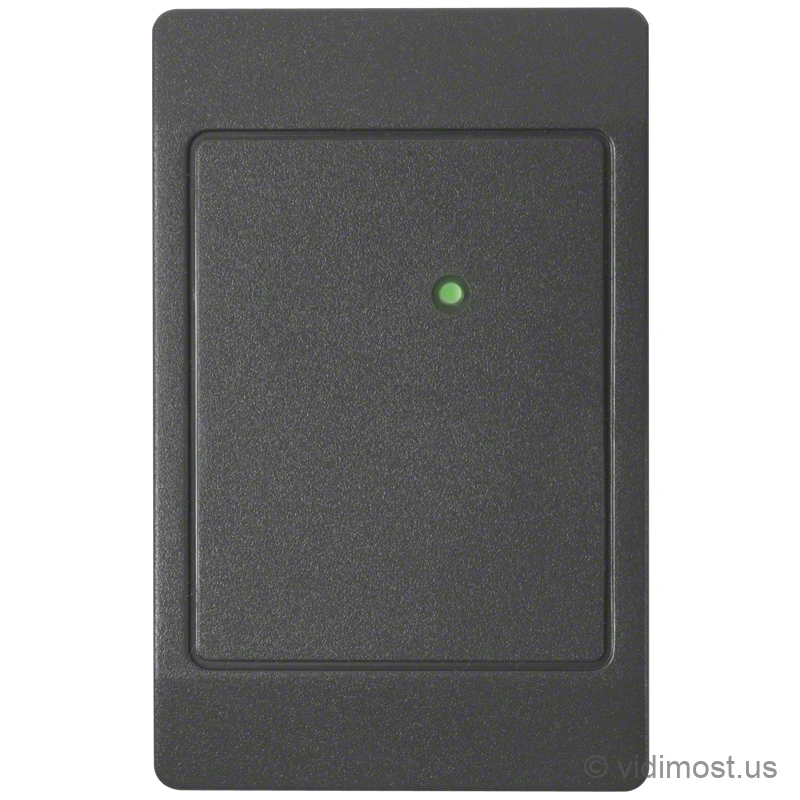
The HID ThinLine II 5395 is a slim 125 kHz HID Prox wall reader that mounts flat over a standard single-gang electrical box. It reads the full HID Prox card and fob family and sends a standard Wiegand signal to your access panel. At about two-thirds of an inch deep, it sits nearly flush on a door frame or wall.
We install and repair access control systems across Chicago, the North Shore and the northwest suburbs — ask about the 5395 for your
building or business.
Credentials read125 kHz HID Prox family (ProxCard II, ISOProx II, DuoProx II, ProxKey II fob, MicroProx tag)
Frequency125 kHz only (no 13.56 MHz smart cards)
Output / commsWiegand (5395). Clock-and-Data on the 5398 sibling
Card formatsUp to 85 bits (over 137 billion codes)
Wiegand up to 500 ft; ALPHA 1295 or equal, 22 AWG shielded
Mounting
Standard US single-gang box / switch-plate footprint. Mounts on metal with little read-range loss
Environment
IP55, -22 to 150 F, UL294, vandal-resistant polycarbonate
Mobile / Bluetooth
No. Card and fob only
Typical use
Security projects in Chicago North Shore – homes, small business and
multifamily buildings, depending on how the system is designed.
How we use it
As part of complete systems (cameras, access control, intercoms, networking)
rather than standalone online sales.
Product overview and installer notes
The ThinLine II 5395 is HID's answer to a common problem: most prox readers stick out too far and look bulky next to a clean door. This one is built on the footprint of a light-switch plate and mounts directly over a US single-gang electrical box, so it sits close to the wall and reads tidy. It measures 4.70 x 3.00 x 0.68 inches, and that 0.68-inch depth is what lets it nearly disappear against a frame. It reads 125 kHz HID Prox credentials only — ProxCard II, ISOProx II, ProxKey II fobs, and the rest of that family — and sends a standard Wiegand signal any existing access panel already understands. The two-piece potted housing is IP55-rated and runs from -22 to 150 F, so the same reader works at a lobby door or an exterior gate. One trait sets it apart from most flat readers: it holds its read range even when screwed straight onto a metal door frame or mullion, where a lot of readers fall apart. For the thinnest, cleanest 125 kHz reader that still takes a beating, this is our default pick.
Specs, firmware notes and availability change over time — confirm against the
manufacturer’s current documentation before ordering.
The thin wall reader that mounts over a single-gang box
Most prox readers are a chunky brick screwed to the wall. The ThinLine II is shaped like a switch plate — 4.70 by 3.00 inches on the face, and only 0.68 inches deep. It drops right over a standard US single-gang electrical box, the same kind an electrician already runs to a light switch, so it sits close to the wall and reads clean next to a door.
That flat profile matters more than it sounds. On a glass storefront entrance, a marble condo lobby, or a rehabbed North Shore vestibule, a reader that projects two inches off the frame looks like an afterthought. This one nearly disappears. The face is plain black with a small status LED and no logo, so it reads as trim hardware rather than a gadget bolted to the wall.
The enclosure is two pieces, fully potted, with replaceable covers — if a cover gets scuffed or tagged over the years, we swap the cover instead of the whole reader. For a building manager, that means one flat reader that stays looking new through tenant turnover and repainting.
If you like the thin look but need 13.56 MHz smart cards or mobile credentials instead of 125 kHz prox, the single-gang iCLASS SE R40 and the multi-tech Signo 40 are the same body size on the wall.
Cards and fobs the 5395 reads: the 125 kHz HID Prox family
This reader speaks one language: 125 kHz HID Proximity. If your building already hands out HID prox cards or key fobs, it reads all of them — ProxCard II, ISOProx II, DuoProx II, ProxCard Plus, the ProxKey II fob, and the MicroProx tag. It also reads the 125 kHz prox side of the older combo 'Proximity & MIFARE' cards, at up to about 5 inches.
It does not read 13.56 MHz smart cards — no iCLASS, no Seos, no MIFARE smart chips, and no phones. If your access is all prox today and you want to keep those cards working, that is exactly the fit: this is a straight replacement or expansion, and nobody has to re-badge. If you are planning to move to smart cards or phone credentials down the road, you would step up to a dual-frequency multiCLASS SE RP40, which reads your old prox cards and new smart cards on the same reader.
On the wire it recognizes card formats up to 85 bits, which covers the standard 26-bit format and the larger corporate and custom formats most access systems issue. Put simply: whatever prox card your current system already trusts, this reader passes through to the panel unchanged.
Power and wiring: standard Wiegand into any panel
The 5395 sends a Wiegand signal, which is the output nearly every access control panel made in the last few decades accepts. That means it drops into an existing system without swapping the controller. Wire runs can go up to 500 feet on the recommended cable — ALPHA 1295 or an equivalent 22 AWG, five-conductor stranded with an overall shield. We land those leads on a door controller like the Paxton Net2 Plus, and the panel handles the door logic.
Power is undemanding: 5 to 16 VDC, drawing around 20 mA at 12 volts, so it runs off the reader power most panels already provide. There is no PoE on this model — it is a two-wire-plus-data reader, not a network device. The reader ships with an 18-inch pigtail, and the multicolor LED and beeper can be driven by the host panel or run on the reader's own logic.
One note on OSDP: this reader is Wiegand only, with no OSDP or RS-485 Secure Channel. If your security policy requires an encrypted, supervised reader-to-panel connection, look at the Signo or iCLASS SE line, which support OSDP Secure Channel. For most prox retrofits, Wiegand is exactly what the existing panel expects. If your panel is a legacy one that only takes mag-stripe readers, HID makes the 5398 sibling with Clock-and-Data output instead.
The real install: exterior gates and metal door frames
The trait that earns this reader a spot on our truck is that it mounts directly on metal with little loss of read range. A prox reader works off a coil, and pressing that coil against a steel door frame, aluminum mullion, or metal gate post usually chokes the range down. HID tuned the ThinLine II to shrug that off, so it goes on the narrow aluminum mullion of a glass entrance door where a bulkier reader would need a spacer or a different spot.
Because it is IP55-rated and runs -22 to 150 F, the same reader works indoors at a mailroom door and outdoors at a parking gate — useful in Chicago, where the same building sees below-zero mornings and hot alley walls in July. The potted UL94 polycarbonate housing is weatherized and vandal-resistant, and HID backs the reader with a lifetime warranty.
For a garden-style or courtyard building, the flat single-gang shape and the metal-mount tolerance mean we can put a clean reader on the frame at each entry without carpentry. For tighter spots like a narrow mullion or a single glass door, the smaller MiniProx 5365 or the compact ProxPoint Plus may fit better — same prox family, different footprint.
Where it fits against its siblings
Think of the 125 kHz prox readers as a set of shapes. The ThinLine II owns the flat, single-gang wall look — the tidiest choice when the reader needs to sit close to the wall on a switch-plate footprint. The MiniProx is the standard mullion reader for a door frame, and the ProxPoint Plus is the smallest of the group for the tightest spots. All three read the same prox cards; you pick by where it mounts and how you want it to look.
Stay with the ThinLine II when your credentials are 125 kHz prox and you want a slim reader over a single-gang box — often the case in condo lobbies and multi-family entries we handle around Chicago and the North Shore. Move up a tier only if you are changing credentials: the multiCLASS SE RP40 adds 13.56 MHz smart cards alongside prox, and the Signo 40 adds smart cards, mobile phone credentials, and OSDP in the same single-gang size.
Not sure which reader your building needs? See our HID lineup or the access control service page, and we will match the reader to your existing cards and panel.
Common questions about the 5395
Will the ThinLine II 5395 work with the prox cards we already hand out?
If those cards are 125 kHz HID Prox — ProxCard II, ISOProx II, DuoProx, ProxKey II fobs, and the like — yes, it reads all of them, and you do not need to re-issue anyone's card. It also reads the 125 kHz prox side of older combo prox-and-MIFARE cards. It does not read 13.56 MHz smart cards or phones, so if your credentials are iCLASS, Seos, or MIFARE smart chips, this is not the right reader.
Can I mount it on a metal door frame or a glass storefront mullion?
Yes, and that is one of its strengths. Unlike most prox readers, the ThinLine II is tuned to mount directly on metal with only minor read-range loss, so it works on steel frames, aluminum mullions, and metal gate posts. Its flat single-gang shape also fits a narrow mullion better than a bulkier reader.
Does it support phones or mobile credentials?
No. This is a 2011-era 125 kHz prox reader — card and fob only, with no Bluetooth, NFC, or HID Mobile Access. If you want tenants to open doors with a phone, look at the Signo line, such as the single-gang Signo 40, which supports mobile credentials and still reads prox during a transition.
How does it wire into our access control panel?
It uses standard Wiegand output, which nearly every access panel accepts, so it drops into an existing system without changing the controller. Runs can go up to 500 feet on 22 AWG shielded cable like ALPHA 1295. It draws 5 to 16 VDC off the panel's reader power and has no PoE. There is no OSDP on this model — if you need an encrypted reader-to-panel link, step up to a Signo or iCLASS SE reader.
What is the difference between the 5395 and the 5398?
Only the output. The 5395 sends Wiegand, which fits almost every modern access panel and is what we install by default. The 5398 sibling sends Clock-and-Data — magnetic-stripe emulation — for older panels that were built to accept mag-stripe readers. Same reader, same prox family, same mounting; you pick the one that matches your panel's input.
Is it okay outdoors in Chicago weather?
Yes. It is IP55-rated with a potted, vandal-resistant polycarbonate housing and is rated from -22 to 150 F, so the same reader works at an interior door or an exterior gate through Chicago winters and summers. HID backs it with a lifetime warranty.
Service, upgrade and maintenance
If you already have HID hardware on site and the system is unstable,
we can audit it, fix urgent issues and plan upgrades step by step instead of
forcing a complete replacement. This includes systems originally installed by
other vendors.
We offer free estimates for projects in our service area. New
service clients also receive a 50% discount on the first service visit
for troubleshooting and diagnostics, including systems we did not install.
To move forward, go to the Contact page and mention model 5395 in your message. You can also attach photos of
your existing equipment, panels or racks to speed up the design and service
process.