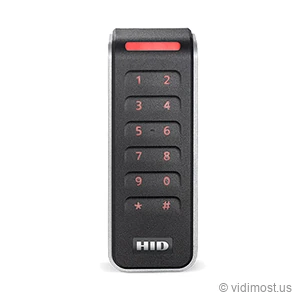
The HID Signo 20K is a mullion-mount door reader with a built-in touch keypad, part of HID's Signo line. It reads 125 kHz prox, 13.56 MHz smart cards, and phone credentials over Bluetooth and NFC, and adds a PIN pad so a narrow door frame can run card-plus-PIN two-factor entry.
We install and repair access control systems across Chicago, the North Shore and the northwest suburbs — ask about the Signo 20K for your
building or business.
Reader typeMullion-mount universal reader with keypad
Keypad12-button (0-9, *, #) capacitive touch, red backlit
HID Mobile Access over Bluetooth and NFC; Apple Wallet employee badge (ECP)
Panel connection
Wiegand or OSDP (RS-485) with native OSDP Secure Channel
Wiring
18 in pigtail or terminal strip (by part number)
Power
12 V DC; Intelligent Power Management cuts draw up to ~43%
Width
45 mm (1.78 in) narrow mullion footprint
Environment
UL294, IP65, indoor/outdoor, -35 C to +66 C
Typical use
Security projects in Chicago North Shore – homes, small business and
multifamily buildings, depending on how the system is designed.
How we use it
As part of complete systems (cameras, access control, intercoms, networking)
rather than standalone online sales.
Product overview and installer notes
Most keypad readers are wide, single-gang units that need a flat wall. The Signo 20K puts a full 12-button capacitive touch keypad on a 45 mm mullion body, so you get card-plus-PIN authentication on a narrow aluminum door frame where a wide reader will not fit. The keypad is capacitive, not mechanical, so there are no moving buttons to jam or wear out, and it backlights red so a resident can find the digits in a dark vestibule. You can run it two ways: a PIN code on its own, or a card or phone tap followed by a PIN. That second mode is real two-factor entry, and it belongs on the doors that matter most in a building, an equipment room, a management office, a pharmacy, a cash room. On top of the keypad it reads the same wide range of credentials as the rest of the Signo family, from legacy 125 kHz prox up through modern smart cards and Apple Wallet phone credentials, and it wires to your access panel over Wiegand or OSDP.
Specs, firmware notes and availability change over time — confirm against the
manufacturer’s current documentation before ordering.
A keypad and card reader on a narrow mullion
Fitting a real PIN pad onto a slim door frame is what sets the 20K apart. Most keypad readers are single-gang boxes built for a flat wall; they will not sit on the aluminum mullion of a glass storefront door. The 20K is 45 mm wide, the same narrow footprint as the keypad-free Signo 20, and it packs a full 12-button pad into that space. On a two-door glass entrance where the frame between the glass and the strike is only a couple of inches wide, this is one of the few readers that gives you a keypad at all.
The keypad is capacitive touch, not mechanical. There are no physical buttons to stick, wear down, or fill with grime, which matters on an outdoor door that sees weather and heavy traffic. The digits and the top light bar backlight red, so a resident or employee can read the pad in a dark entry.
You run the reader in one of two modes, and the gap between them is the security decision. Code-only means a person types a PIN and the door opens, no card needed. That is convenient, but a PIN alone can be shared, watched over a shoulder, or guessed, so treat code-only like a shared password, fine for a low-stakes door, weak for anything sensitive. Card-plus-PIN means the person taps a card or phone and types their code. Now an entry needs something they carry and something they know, which is true two-factor, and a lost or cloned card is useless without the PIN.
Because you choose the mode per reader in your access software, a common setup is to leave the building's front door on card or phone tap for easy resident access, then require card-plus-PIN on the doors that actually need it: the electrical and network room, the property management office, a pharmacy or clinic suite, a cash-handling room. That is exactly where the 20K earns its keypad, on the handful of interior doors where a single lost fob should not be enough to get in.
Credentials the 20K accepts: old prox, new smart cards, and phones
Setting the keypad aside, the 20K reads the same broad mix of credentials as the rest of the Signo line, which makes it useful in a building that is mid-migration. On the old side it reads 125 kHz proximity, the low-frequency tech behind classic HID Prox, Indala, AWID, and EM cards and fobs, the same signal a plain MiniProx reads. On the modern side it reads 13.56 MHz smart cards, which are encrypted and far harder to clone: Seos, HID iCLASS, MIFARE Classic, and MIFARE DESFire EV1, EV2, and EV3 (EV3 needs reader firmware 10.0.2.4 or newer).
Reading both frequencies means you retire cards on your own schedule instead of in one disruptive push. Hang 20K readers, and they honor the old 125 kHz fobs already in people's pockets while you hand out new encrypted credentials as tenants turn over or as old cards wear out. Once the last low-frequency fob is gone, you switch off 125 kHz in software and the same readers keep running. HID says the Signo readers support more than 15 common credential technologies, so an odd legacy card is likely to still work.
Phones count as a credential too. The 20K is mobile-ready out of the box: it reads HID Mobile Access credentials over both Bluetooth and NFC, and it supports employee badges in Apple Wallet through Apple's Enhanced Contactless Polling, so a resident or staffer taps a phone or watch instead of a card. That mobile support pairs naturally with card-plus-PIN, a phone tap plus a code, no plastic card in the mix at all.
Power and wiring to your controller
The 20K runs on 12 volts DC and talks to your access control panel two ways. Wiegand is the older point-to-point wiring most existing panels use; the reader sends the card number back over a few dedicated wires. This is how it lands on a Paxton Net2 door controller or most legacy panels already in a building.
OSDP (over RS-485) is the newer path, and it is worth asking for on any door you care about. OSDP is a two-way, encrypted connection between the reader and the panel using OSDP Secure Channel, which every Signo ships with out of the box. It stops the wire-tap and card-replay tricks that plain Wiegand is open to, it lets one pair of wires run several readers in a line, and it lets you push firmware and settings to the reader remotely instead of pulling it off the wall.
With a keypad in the mix, the panel and your access platform need to accept a PIN alongside the card read, so confirm your controller supports card-plus-PIN before you commit to that mode. The reader comes in a pigtail version (an 18-inch tail you splice to) or a terminal-strip version (screw terminals in the back), so you pick whichever your install and code inspector prefer. On its power draw, Intelligent Power Management trims current consumption by up to about 43 percent in its low-power mode, which helps when you have a run of readers on one power supply. We cover the panel side of all this on our access control page.
Mounting and the real install
The 20K mounts on a door mullion or any flat surface. It is IP65 and UL294 rated for indoor or outdoor use, and it holds up from -35 C to +66 C, which is the full Chicago range from a January cold snap to an August loading dock in the sun.
One install detail is worth knowing up front. Set a reader against metal, and an aluminum mullion counts, and the read range drops, so a resident may have to bring a card in closer than they expect. The 20K fights that with surface-detection that senses what it is mounted on and re-tunes the read range to match, which recovers most of the loss. On a metal mullion HID still calls for the plastic reader spacer behind the unit to bring the range all the way back, and we carry those spacers on the truck and fit them where the surface calls for it.
Where the 20K fits against its siblings
The 20K is the keypad member of the mullion Signo pair. If you do not need a PIN pad, the Signo 20 is the same narrow reader without the keypad, cleaner and a bit cheaper for a plain tap-to-enter door. If you want the keypad but need it on a wider single-gang wall box instead of a mullion, step up to the Signo 40K, which is the single-gang reader with a keypad; the plain single-gang version is the Signo 40.
Coming from older hardware, the 20K is the natural upgrade for a mullion running plain prox. A MiniProx or multiCLASS SE RP15 reads cards but has no way to demand a PIN; swapping in a 20K keeps every card working and adds the keypad on the doors that need two-factor. For the full lineup and where each reader lands, see our HID overview.
Common questions about the Signo 20K
Do I have to use the PIN keypad?
No. You set the mode per reader in your access software. You can run the 20K as a plain tap-to-enter reader (card or phone only), as code-only (PIN with no card), or as card-plus-PIN two-factor. A common building setup taps to enter on the front door and requires card-plus-PIN only on sensitive interior doors.
Will the 20K read the old fobs my building already hands out?
Very likely yes. It reads 125 kHz prox (HID Prox, Indala, AWID, EM) alongside modern 13.56 MHz smart cards like Seos, iCLASS, MIFARE Classic, and DESFire, so it honors existing low-frequency fobs while you issue new encrypted credentials. When the old cards are retired, you turn off 125 kHz in software and keep the same readers.
Can residents use their phone instead of a card?
Yes. The 20K reads HID Mobile Access credentials over both Bluetooth and NFC, and it supports employee badges in Apple Wallet using Apple's ECP, so a phone or watch tap works. You can even pair a phone tap with a PIN for two-factor entry and skip plastic cards entirely on your high-security doors.
How does it wire to my existing access control panel?
It connects over Wiegand (the older point-to-point wiring on most legacy panels) or OSDP over RS-485, which is the newer encrypted two-way path with OSDP Secure Channel built in. It runs on 12 V DC and comes in a pigtail or terminal-strip version. If you plan to use card-plus-PIN, confirm your controller and platform accept a PIN with the card read.
Should I get the 20K or the keypad-free Signo 20?
Get the 20K if you want a PIN on that door, either code-only or card-plus-PIN two-factor. Get the Signo 20 if the door only needs a card or phone tap; it is the same narrow mullion reader without the keypad. Both read the same range of credentials, so the keypad is the only real decision.
It's going on an aluminum door frame. Will the read range suffer?
Mounting any reader on metal shortens its read range, but the 20K has surface-detection that re-tunes for the surface it sits on, which brings back most of it. On a metal mullion HID recommends a plastic reader spacer behind the unit to restore full range, and we fit one where the mounting surface calls for it.
Service, upgrade and maintenance
If you already have HID hardware on site and the system is unstable,
we can audit it, fix urgent issues and plan upgrades step by step instead of
forcing a complete replacement. This includes systems originally installed by
other vendors.
We offer free estimates for projects in our service area. New
service clients also receive a 50% discount on the first service visit
for troubleshooting and diagnostics, including systems we did not install.
To move forward, go to the Contact page and mention model Signo 20K in your message. You can also attach photos of
your existing equipment, panels or racks to speed up the design and service
process.