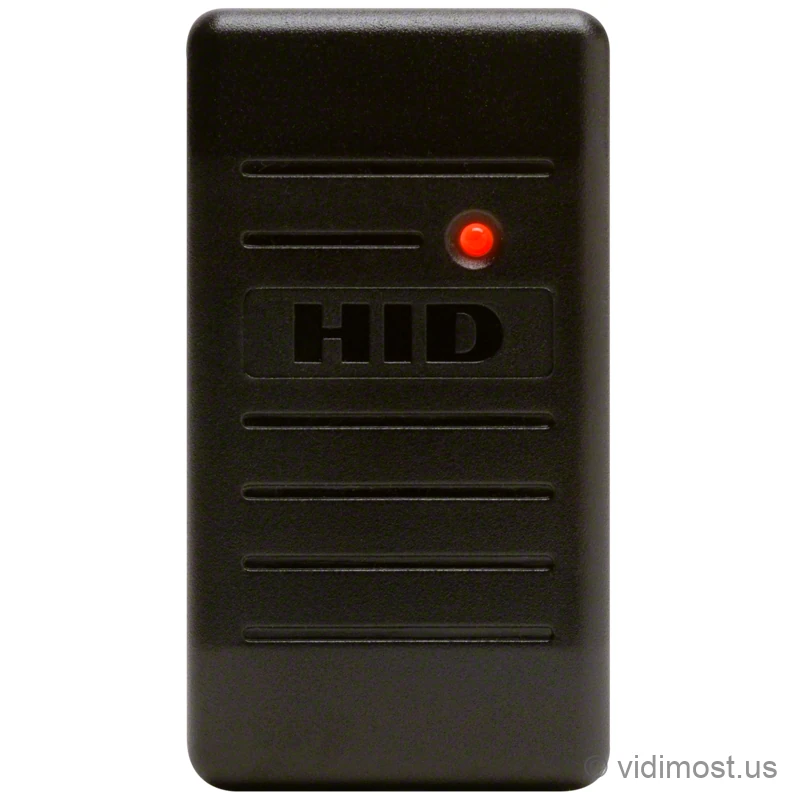
The HID ProxPoint Plus 6005 is one of HID's smallest 125 kHz Prox readers — a compact, fully potted mullion unit for tight mounting spots. It reads standard HID Prox cards and fobs (ProxCard II, ISOProx II, ProxKey II) and outputs Wiegand to any standard access control panel. No smart-card or mobile support.
We install and repair access control systems across Chicago, the North Shore and the northwest suburbs — ask about the 6005 for your
building or business.
Credential technology125 kHz HID Prox (low-frequency) only
Cards & fobs readProxCard II, ISOProx II, DuoProx II, ProxKey II fob, MicroProx Tag
Up to 500 ft (150 m) on 22 AWG, pigtail terminated
Mounting
Compact mullion-mount; mounts directly on metal
Environment
IP55, potted polycarbonate, indoor/outdoor, -22 to 150°F
Mobile support
None — no Bluetooth, NFC, or wallet credentials
Typical use
Security projects in Chicago North Shore – homes, small business and
multifamily buildings, depending on how the system is designed.
How we use it
As part of complete systems (cameras, access control, intercoms, networking)
rather than standalone online sales.
Product overview and installer notes
The ProxPoint Plus 6005 earns its spot on the truck when a door frame has almost no room to work with. It's among the smallest readers HID makes — a potted black unit measuring 3.14" x 1.72" x 0.66" — so it fits narrow door mullions, gate posts, and turnstile columns where a full-size reader won't sit flat. It reads 125 kHz HID Prox credentials only (cards and fobs up to 85-bit formats) and sends that card number over Wiegand to any standard access control panel. The 6005B model is Wiegand; a sibling model, the 6008B, outputs Clock-and-Data instead. It mounts directly onto metal with no change in read range, which is why installers reach for it on steel frames where bigger readers lose distance. IP55-rated and built for both indoor and outdoor Chicago weather, it carries a lifetime warranty. When a 125 kHz door comes down to space and budget, this is the unit that fits both.
Specs, firmware notes and availability change over time — confirm against the
manufacturer’s current documentation before ordering.
The reader for tight spots on a 125 kHz door
Some doors just don't have room. A glass storefront with a thin aluminum stile, a swing gate on a narrow post, a turnstile column, a metal frame with a two-inch face — a standard reader hangs off the edge or won't sit flat. The ProxPoint Plus 6005 is built for exactly those spots. At 3.14" x 1.72" x 0.66" it's one of the smallest readers HID makes, and the whole unit is potted solid, so there's no housing to crack and no gap for water to find.
It's also the low-cost end of HID's 125 kHz line. If a property already runs standard HID Prox cards and you need to add a door — or replace a dead reader — this is the least expensive way to do it without changing anything else in the system. The card number goes out over Wiegand, which nearly every access panel already speaks, so it drops in as a like-for-like swap. When the constraint on a 125 kHz door is space or budget, the 6005 covers both.
The trade-off is scope. It's small and it's cheap because it does one job — read a 125 kHz Prox card and pass it along. If you want a wider face, a keypad, smart cards, or phone-based entry, those live on other readers in the family, linked below.
Credentials the 6005 accepts
This is a 125 kHz HID Prox reader, the older low-frequency proximity standard. It reads the common HID Prox credentials a Chicago building is likely already carrying: ProxCard II, ISOProx II (the printable clamshell-thin card), DuoProx II, the ProxKey II key fob, and the MicroProx Tag. It handles HID Prox card formats up to 85 bits, which is far more unique numbers than any single building will ever use.
What it does not do is read 13.56 MHz smart credentials — no iCLASS, no Seos, no smart-card MIFARE data — and it has no mobile support. There's no Bluetooth, no NFC, no phone-in-wallet entry. If you want residents opening doors with their phones, this is the wrong reader; the Signo Express or an iCLASS SE R15 handle that. The 6005 is a deliberately simple, single-purpose reader for buildings standardized on 125 kHz cards.
Power and wiring — how it connects to your panel
Wiring is straightforward. The 6005 runs on 5 to 16 volts DC and draws very little — about 30 mA on average, 75 mA at peak — so it doesn't tax a power supply. There's no PoE option; it's powered from your access control panel or a separate 12V supply like every other reader on the door. HID recommends a linear supply to keep the read range clean.
The 6005B model outputs Wiegand, the long-standing reader-to-panel protocol, over a factory pigtail. You can run that cable up to 500 feet on 22 AWG back to the controller, which covers almost any single building. Wiegand works with virtually any access panel — a Paxton Net2 door controller, a legacy board, or a cloud platform like Brivo. Note there's no OSDP or RS-485 on this reader; if your spec requires OSDP Secure Channel, step up to a Signo 20. The 6008B sibling model swaps Wiegand for Clock-and-Data (magstripe emulation) if that's what an older panel needs.
Mounting and the real install
The reason installers keep this one on the truck is how it behaves on metal. Most prox readers detune when they're screwed onto steel — the read range shrinks or the reader quits altogether. The 6005 was engineered around that problem: it mounts directly onto metal with no change in read range, so it reads the same on a steel door mullion or an aluminum gate post as it does in open air, no spacer or shim required. That saves real time on commercial glass entrances and exterior gates.
The enclosure is sealed UL94 polycarbonate, potted and IP55-rated, so it holds up to a Chicago winter and summer alike — the operating range runs from -22°F to 150°F. It has a good degree of vandal resistance from the solid potting, though HID doesn't publish a formal impact (IK) rating, so for a high-abuse entry we'd talk through the location with you. It carries a lifetime warranty. We install and service these across access control jobs in Chicago and the North Shore.
Where it fits against its siblings
Inside HID's 125 kHz line, the 6005 is the small, low-cost end. The MiniProx 5365 is a slightly larger mullion prox reader with longer read range; the ThinLine II 5395 is a thin flat reader for wall boxes rather than tight frames. All three read the same 125 kHz cards — pick by the space you have and the range you need.
If you're planning ahead, know that 125 kHz Prox is the older, less secure technology. To keep the same small mullion footprint but add modern 13.56 MHz smart cards, the multiCLASS SE RP10 reads both prox and smart cards. That lets you migrate at your own pace: leave the old ProxCards working, hand new residents smart credentials as they move in, and shut off 125 kHz in software once the last old card is retired. To go current on everything — smart cards plus phones — the Signo 20 is HID's newest mullion reader. See the full HID reader lineup to compare. If the door already uses 125 kHz cards and you just need to fit a reader in a tight spot cheaply, the 6005 is the answer.
Common questions about the 6005
Will the 6005 work with my existing access control system?
Almost certainly, if it's a 125 kHz HID Prox system. The 6005B outputs Wiegand, the standard reader-to-panel protocol that nearly every access panel accepts, so it drops in as a like-for-like reader swap. It reads standard HID Prox cards and fobs your building may already carry — ProxCard II, ISOProx II, ProxKey II, and others.
Does it read phones or mobile credentials?
No. The 6005 is a 125 kHz Prox reader only. It has no Bluetooth, NFC, or wallet support, so residents can't use their phones with it. If phone-based entry matters, look at the HID Signo Express or the iCLASS SE R15, which are built for mobile.
Why pick the 6005 over the MiniProx or a full-size reader?
Space and cost. It's one of HID's smallest readers and the least expensive in the 125 kHz line, so it's the pick for narrow mullions, gate posts, and turnstiles where a bigger reader won't fit or isn't worth the money. If you have more room and want longer read range, the MiniProx 5365 is the step up. Both read the same cards.
Can I mount it on a metal door frame?
Yes — that's a strength of this reader. Most prox readers lose range when mounted on metal, but the 6005 is designed to mount directly onto steel or aluminum with no change in read range. No spacer or shim needed, which is why it's a common choice for commercial glass entrances and exterior gates.
Does it support OSDP or Secure Channel?
No. This reader is Wiegand only (the 6005B model) or Clock-and-Data (the 6008B model). There's no OSDP or RS-485 wiring. If your project specification requires OSDP Secure Channel, step up to a reader like the HID Signo 20, which supports it.
Is it rated for outdoor use in Chicago weather?
Yes. The 6005 is IP55-rated with a fully potted polycarbonate enclosure and an operating range of -22°F to 150°F, so it handles Chicago winters and summers outdoors. The solid potting also gives it good vandal resistance, though HID doesn't publish a formal impact rating — for a high-abuse door we'd review the location with you. It carries a lifetime warranty.
Service, upgrade and maintenance
If you already have HID hardware on site and the system is unstable,
we can audit it, fix urgent issues and plan upgrades step by step instead of
forcing a complete replacement. This includes systems originally installed by
other vendors.
We offer free estimates for projects in our service area. New
service clients also receive a 50% discount on the first service visit
for troubleshooting and diagnostics, including systems we did not install.
To move forward, go to the Contact page and mention model 6005 in your message. You can also attach photos of
your existing equipment, panels or racks to speed up the design and service
process.