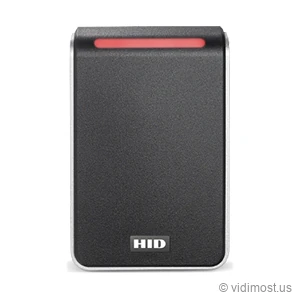
The HID Signo 40 is a single-gang wall reader from HID's newest Signo line. It reads 125 kHz prox, 13.56 MHz smart cards, and phones over Bluetooth, NFC, and Apple Wallet, and mounts over a standard switch box for door entry. It talks to a controller over OSDP or Wiegand.
We install and repair access control systems across Chicago, the North Shore and the northwest suburbs — ask about the Signo 40 for your
building or business.
Form factorSingle-gang wall reader (covers a standard switch box)
Credentials read125 kHz prox (HID/Indala/AWID/EM), 13.56 MHz smart (Seos, iCLASS SE, MIFARE DESFire EV1-EV3), plus mobile
Mobile supportHID Mobile Access over Bluetooth + NFC; Apple Wallet employee badge (ECP)
Panel commsRS-485 Half Duplex (OSDP with Secure Channel), Wiegand, or Clock-and-Data
Remote config and firmware via HID Reader Manager or over OSDP
Typical use
Security projects in Chicago North Shore – homes, small business and
multifamily buildings, depending on how the system is designed.
How we use it
As part of complete systems (cameras, access control, intercoms, networking)
rather than standalone online sales.
Product overview and installer notes
The Signo 40 is the wall-plate reader in HID's Signo family, sized to cover a single-gang switch box next to a door. Its install story is what sets it apart: a surface-detection feature auto-tunes the antenna to the mounting surface, so read range stays usable even when the reader sits on a metal door frame or an aluminum mullion where older readers went dead. The polycarbonate housing is IP65-rated and runs from -35C to +66C, so the same part works on a heated lobby door or an exposed gate. It terminates over RS-485 for OSDP or over Wiegand, wires to the panel through an 18 in pigtail or a terminal strip, and runs on 12V DC. On the credential side it reads nearly every card past to present plus mobile, which makes it a clean drop-in when you are replacing an old iCLASS SE R40 or a legacy R40/RP40 without re-badging the building. It is the single-gang sibling to the mullion-width Signo 20.
Specs, firmware notes and availability change over time — confirm against the
manufacturer’s current documentation before ordering.
Built for the mounting surface, not just the credential
Most reader spec sheets bury the install detail. This one leads with it, because the Signo 40 is easier to place than the readers it replaces. It carries a surface-detection feature that senses the material behind it and re-tunes the antenna on power-up. In practical terms: mount it on an aluminum door frame or a metal mullion and it recalibrates so the read range does not collapse the way a legacy reader's would.
Bare metal still shaves off some distance. HID says so, and so do we. When the reader has to sit flat against a metal surface, we slip in the plastic spacers HID ships with it to raise the antenna off the metal and win back range. On a wood or drywall jamb you usually skip them. Either way the reader tunes itself to whatever it is bolted to.
The slotted mounting plate is the other quiet win. It lines up over a single-gang switch box but the slots allow some slop in back-box spacing, so a box that was set a little off from a previous reader still lands clean. The housing is polycarbonate rated UL94 V0, it is IP65, and it runs from -35C to +66C. That is one part number for a heated lobby door and an exposed courtyard gate, which is exactly the range a Chicago and North Shore property mixes across one building.
Cards, fobs, and phones the Signo 40 accepts
The Signo 40 is a multi-technology reader, which means it reads two different radio bands plus phones from a single face. The 125 kHz band covers the old proximity cards and fobs almost every older building still carries: HID Prox, Indala, AWID, and EM. The 13.56 MHz band covers modern encrypted smart cards: Seos, iCLASS SE, and MIFARE DESFire EV1 through EV3. HID lists support for more than 15 credential technologies on one device.
That range earns its keep during a migration. Say half your residents still carry 15-year-old prox fobs and you want new tenants on encrypted Seos cards or their phones. This reader takes both at the same door from day one, so you can move a building over unit by unit at whatever pace the property allows. Once every resident is switched, you turn off the legacy 125 kHz technology in HID Reader Manager and the security gap that old prox cards leave open goes away. For a straight prox-only upgrade path, the mullion-format multiCLASS SE RP40 and the smaller MiniProx are the older siblings this replaces.
Power and how it wires to a controller
The Signo 40 runs on 12V DC and draws little: roughly 65 mA on standby, 250 mA at peak. There is no Power over Ethernet here, so it takes power from the access panel or a local supply, not from a network switch. An Intelligent Power Management mode trims draw further on installs where you are counting milliamps across many doors.
It connects to a controller three ways: OSDP over RS-485, plain Wiegand, or Clock-and-Data. OSDP is our default on new work. It is a two-wire bus that carries encrypted, mutually authenticated traffic through OSDP Secure Channel, so the line between the reader and the panel cannot be tapped or spoofed the way a bare Wiegand run can. OSDP also runs much farther, up to 4,000 ft versus about 500 ft for Wiegand.
If your panel is older and only speaks Wiegand, the Signo 40 still drops right in on those terminals. It wires through an 18 in pigtail or a terminal strip, and it pairs cleanly with a controller like the Paxton Net2 Plus. When the head end is a cloud platform such as Brivo, we spec the reader to match the panel's supported protocol before install. See our access control service for how we handle the panel side.
Where it fits against its siblings
The Signo 40 is the single-gang, wall-plate unit. If the door has a narrow metal mullion instead of a flat jamb, its sibling the Signo 20 is the slimmer mullion body with the same electronics. Need a PIN as well as a card at the door? The Signo 40K is this same wall reader with a keypad, and the Signo 20K is the mullion version with a keypad.
If the building is mobile-first and you do not need to read older prox cards, the budget Signo Express covers phones and modern smart cards for less. Choose the Signo 40 when you want the full card range, a wall-plate footprint, and the surface-tuning that keeps it working on metal. It is the direct form-fit successor to the older HID R40 and RP40, so it usually drops onto the existing back box and wiring. More HID options live on the HID brand page.
Common questions about the Signo 40
Will the Signo 40 read the prox cards and fobs my building already uses?
Almost certainly. It reads 125 kHz prox including HID Prox, Indala, AWID, and EM, which covers the great majority of legacy fobs still in the field. It also reads modern 13.56 MHz smart cards (Seos, iCLASS SE, MIFARE DESFire) and phones on the same face, so you can run old and new credentials at one door during a switch-over. Send us a sample card and we will confirm the exact format before you order.
Can it replace my old HID R40 or RP40 without new wiring?
Usually yes. The Signo 40 is the form-fit successor to the R40 and RP40, so it typically mounts on the same single-gang back box and reuses the existing Wiegand or OSDP wiring. The slotted mounting plate also forgives back-box spacing that is slightly off. We check the panel's protocol and the existing cable run on-site before we call it a straight swap.
Does it support phones and Apple Wallet?
Yes, out of the box. It reads HID Mobile Access credentials over Bluetooth and NFC, and it supports employee badges in Apple Wallet through Apple's Enhanced Contactless Polling. That means a resident or staff member can hold up a phone instead of a card. Mobile credentials are issued through the HID Origo platform, which we set up as part of the install.
Will it still work if I have to mount it on a metal door frame?
Yes, and this is a real strength of the Signo line. A surface-detection feature re-tunes the reader to whatever it is mounted on, so range stays usable on metal where older readers went dead. Bare metal does trim the distance, so when the reader sits flat against it we add the plastic spacers HID supplies to lift the antenna and recover range.
Should I choose the Signo 40 or the Signo 20?
It comes down to the mounting surface. The Signo 40 is the wider single-gang unit for a flat door jamb or wall next to the door. The Signo 20 is the narrow mullion body for a slim metal door frame where the 40 will not fit. The electronics and credential support are the same, so pick by the door, not by the features.
OSDP or Wiegand for the panel connection?
Use OSDP if your panel supports it. It is a two-wire bus with OSDP Secure Channel, which encrypts and authenticates the traffic between reader and panel so the line cannot be tapped or spoofed, and it runs up to 4,000 ft. Wiegand is fine on older panels that only speak it, and the Signo 40 drops onto those terminals too, but the run is limited to about 500 ft and the traffic is not encrypted.
Service, upgrade and maintenance
If you already have HID hardware on site and the system is unstable,
we can audit it, fix urgent issues and plan upgrades step by step instead of
forcing a complete replacement. This includes systems originally installed by
other vendors.
We offer free estimates for projects in our service area. New
service clients also receive a 50% discount on the first service visit
for troubleshooting and diagnostics, including systems we did not install.
To move forward, go to the Contact page and mention model Signo 40 in your message. You can also attach photos of
your existing equipment, panels or racks to speed up the design and service
process.